Platinum Tree Financial
  • SERVICES
    • BUSINESS OWNERS
      • FINANCIAL ADVICE
      • RISK MANAGEMENT PLANNING
      • INSURANCE PLANNING
      • SUCCESSION PLANNING
      • EMPLOYEE BENEFITS
        • HEALTH BENEFITS
        • RETIREMENT BENEFITS
        • HEALTH SPENDING ACCOUNT
    • INCORPORATED PROFESSIONALS
      • FINANCIAL ADVICE
      • HEALTH SPENDING ACCOUNT
    • INDIVIDUALS & FAMILIES
      • FINANCIAL ADVICE
      • RISK MANAGEMENT PLANNING FOR YOUNG FAMILIES
      • RISK MANAGEMENT PLANNING FOR RETIREES & MATURE FAMILIES
      • INSURANCE PLANNING
    • INSURANCE
      • INSURANCE PLANNING FOR FAMILIES
      • INSURANCE PLANNING FOR BUSINESS OWNERS
      • DISABILITY
      • CRITICAL ILLNESS
      • LIFE
        • PERSONAL
        • CORPORATE
      • HEALTH INSURANCE
      • LONG TERM CARE INSURANCE
      • TRAVEL INSURANCE
      • CREDITOR INSURANCE
    • RISK MANAGEMENT
      • YOUNG FAMILIES
      • RETIREES AND MATURE FAMILIES
      • BUSINESS OWNERS
    • TAX DRIVEN STRATEGIES
      • INSURED RETIREMENT PROGRAM
      • SHARED OWNERSHIP CRITICAL ILLNESS
      • IMMEDIATE FINANCING ARRANGEMENT
      • CORPORATE ESTATE BOND
  • ABOUT
    • ABOUT
    • SUPPLIERS
    • PRIVACY & WEBSITE TERMS OF USE
  • NEWS
  • CONTACT
  • Menu Menu

Archive for category: health benefits

Renewing Your Group Benefits Plan

November 4, 2024/in Blog, business owners, Group Benefits, health benefits, incorporated professionals/by Platinum Tree Financial

When it’s time to renew your organization’s group benefits plan, it’s a chance to step back, take a close look, and ensure everything still makes sense for your team and budget. Each year, your provider will review past claims and usage to help adjust coverage and premiums, so the plan remains relevant. Here’s how to get the most out of this process.

Reviewing Your Benefits: Focus on What Matters

Take time to examine each part of your benefits package to see if it still meets the needs of your team:

  • Health Coverage: Look at what’s covered for prescription drugs, hospital care, and specialist visits. Are the current limits in line with what your team uses most?
  • Dental Coverage: From cleanings to crowns, check that the plan covers routine and advanced dental needs. If usage is low, maybe it’s time for an update.
  • Disability and Life Insurance: Disability insurance protects income during tough times, while life insurance gives peace of mind. Make sure coverage levels are right for your team.
  • Critical Illness and Accident Insurance: These benefits can provide extra financial support for serious illnesses or accidents, with options for additional coverage if it’s a priority for employees.

Specialty Benefits That Add Flexibility

Consider adding options that give employees more control over their benefits:

  • Health Care Spending Accounts (HCSAs): With HCSAs, employees have a set allowance to cover eligible health expenses. This flexibility lets employees pick and choose the coverage that fits their needs.
  • Emergency Medical Coverage: This can be particularly valuable for employees who travel frequently, covering unexpected medical costs on the road.
  • Retiree and Self-Employed Benefits: If you offer benefits for retirees or contractors, make sure these plans focus on the essentials, like prescriptions, dental, and vision, to keep things simple and effective.

Checking Value and Staying on Budget

Once you know what you’re covering, see if it aligns with what your team values most and if it’s worth the premium cost:

  • Utilization Analysis: Look at which benefits are most used. If something like dental care isn’t being used much, that could mean there’s room to adjust.
  • Employee Feedback: Ask employees directly what benefits do they find most valuable? This feedback can guide your decisions.

Making the Right Adjustments

When you have the full picture, it’s time to consider if adjustments would make the plan stronger or more efficient:

  • Benefit Modifications: Maybe it’s time to add a health spending account, adjust critical illness coverage, or tweak other benefits to better reflect what employees want.
  • Cost-Sharing Adjustments: Evaluate how the premium costs are split. Adjusting the cost share may help keep the plan sustainable for everyone.

With the right approach to your group benefits renewal, you can keep your plan valuable, easy to understand, and tailored to what your team needs most. This way, you’re not just offering a benefits package—you’re providing a solution that works.

https://platinumtreefinancial.ca/wp-content/uploads/2024/11/gbplan.jpg 300 500 Platinum Tree Financial https://platinumtreefinancial.ca/wp-content/uploads/2020/03/platinumTreeEnfold.jpg Platinum Tree Financial2024-11-04 12:00:402024-11-04 12:00:48Renewing Your Group Benefits Plan

What is disability insurance?

August 1, 2024/in Blog, business owners, disability, disability insurance, Family, farmers, financial advice, health benefits, incorporated professionals, individuals, Insurance, Professionals/by Platinum Tree Financial

If you cannot work because you are seriously injured or ill, disability insurance will provide you with a monthly, tax-free income to help replace your lost wages.  An injury does not have to be as blatant as a broken leg or arm – suffering from chronic pain or dealing with mental health issues can also qualify you for a disability insurance payout.  

Why do I need disability insurance?

Unfortunately, people become disabled – whether temporarily or permanently – quite often. In 2017, over 20 percent of Canadians had one or more disabilities. 

If you’re disabled, you may lose one of your most valuable assets – your ability to work and bring in a paycheck. Disability insurance can help replace that paycheck for as long as you need it to. Being able to rely on a disability insurance payout means you won’t have to dip into your savings if anything happens to you.

Disability insurance is especially important if you are self-employed, particularly if you are the family’s sole income earner.

What if I already have disability insurance through work?

If you have disability insurance through work, that’s great – but it may not replace 100 percent of your paycheck, especially if you’re off work for a long time. If you purchase private disability insurance, you can:

  • Choose how much coverage you want.
  • Adjust your coverage as needed.
  • Not have to worry if you leave your employer – you won’t lose your disability insurance coverage.

Having private disability insurance will give you peace of mind that you either have additional coverage if you are employed and at least some disability coverage if you lose your job.

How does disability insurance work?

We’d be happy to answer any questions you have about disability insurance. There are five main steps to disability insurance:

  1. Determine the amount of coverage you want. The higher your salary, the more coverage you should get.
  2. Pay your monthly premiums. Factors like your health, your age, and the amount of coverage you have will all impact the cost of your premiums.
  3. File a claim if you become disabled – we can help you with this.
  4. Receive your monthly payments once your waiting period has passed – a longer waiting period can lower your premiums, but it does mean you’ll go longer without any income.
  5. When you are healthy enough to return to work, or your coverage period runs out, you will stop receiving disability insurance payments.

We’re Here To Help

If you’d like to know more about disability insurance – from how much it would cost you to what you can file a claim for – we’re here to help! Give us a call today.

https://platinumtreefinancial.ca/wp-content/uploads/2024/08/What-is-disability-insurance.jpg 300 500 Platinum Tree Financial https://platinumtreefinancial.ca/wp-content/uploads/2020/03/platinumTreeEnfold.jpg Platinum Tree Financial2024-08-01 06:00:352024-08-01 10:49:49What is disability insurance?

Exploring the Value of Group Benefit Plans for Your Employees

March 1, 2024/in Blog, business owners, Group Benefits, health benefits, incorporated professionals/by Platinum Tree Financial

In today’s ever-evolving workplace landscape, employees place a premium on several key factors:

1. Alignment with employer values, especially sustainability.

2. Achieving a harmonious work-life balance.

3. Assistance in coping with the rising cost of living expenses.

4. Opportunities for delayed retirement.

5. Cultivating a sense of belonging within the workplace.

6. Flexibility in terms of work hours and location.

7. Ensuring job security.

If your business is experiencing growth and you’re considering adding group benefit plans to your employee offerings, you’re in the right place. We understand the importance of providing the right employee benefits solution for your business.

Understanding Group Benefit Plans and Their Value

Group benefit plans form a crucial part of a company’s total compensation package, available to employees regardless of their seniority, position, or qualifications. These plans often encompass medical coverage for employees and their dependents. While it may seem like an additional expense during a period of growth, offering employee insurance benefits is essential for the long-term sustainability of your business.

So, why should your company consider offering group insurance benefits? Here are some compelling reasons:

1. Convenience: Group insurance benefits simplify healthcare coverage for your employees and their families.

2. Workforce Protection: These benefits provide a safety net for your staff, promoting their well-being.

3. Staff Retention: Offering benefits can help you retain valuable employees, reducing turnover.

4. Tax Benefits: Group insurance plans offer tax advantages for both employers and employees.

5. Customization: Plans can be tailored to meet your business’s unique needs.

6. Morale Boost: Providing benefits can boost productivity and morale among your workforce.

What’s Covered by Group Insurance Plans?

Group insurance plans typically cover medical-related expenses that provincial healthcare plans might not fully address. This coverage can include paramedical and ambulance services, dental care, eye care, hospital stays, and certain prescription drugs. Additionally, you have the option to combine group benefits plans with retirement and savings plans.

Types of Group Benefits Plans

Various types of group benefits plans are available, each catering to different company needs and preferences. The most popular options include:

1. Fully-Insured

2. Self-Funded

3. Level-Funded

No matter the size of your business, there’s a group insurance benefit plan that suits your needs. We offer flexible and innovative plans that anticipate your requirements. Our services aim to reduce your administrative workload, allowing you to focus on critical aspects of your business.

Is Group Insurance Cost-Effective?

One of the financial advantages of group insurance is lower premiums while maintaining coverage equivalent to individual health insurance. Typically, employers cover most of the group benefit plan costs, with employees contributing a small percentage of their salary towards the monthly premium. If you’re concerned about the tax implications of providing benefits at work, it’s advisable to with us for specific details.

In conclusion, offering group benefit plans is a strategic move to attract and retain top talent while promoting employee well-being and financial security. Whether you have a small or large business, we are here to assist you in finding the right plan that aligns with your organization’s needs and objectives.

https://platinumtreefinancial.ca/wp-content/uploads/2024/03/Types-of-Group-Benefits-Plans.jpg 300 500 Platinum Tree Financial https://platinumtreefinancial.ca/wp-content/uploads/2020/03/platinumTreeEnfold.jpg Platinum Tree Financial2024-03-01 06:00:392024-03-01 11:36:45Exploring the Value of Group Benefit Plans for Your Employees

Protecting Key Talent using Group Benefits

October 2, 2023/in 2023, Blog, business owners, corporate, dental benefits, disability, Group Benefits, health benefits, Insurance, life insurance, pension plan, Professional Corporations, Professionals, retirement/by Platinum Tree Financial

Building a Sustainable Future Together

As a group benefits specialist, our main objective is to foster a sustainable future by working in partnership with our clients. We believe that a knowledgeable and engaged workforce is essential for any organization’s success. One of the crucial aspects of achieving this goal is protecting key talent within your company. In this article, we will explore how group benefits can play a significant role in safeguarding your organization’s most valuable asset: its people.

The Value of Key Talent

Key talent refers to those employees who possess critical skills, expertise, and knowledge that drive your company’s growth and success. They are the backbone of your organization, ensuring it thrives in today’s competitive landscape. Retaining these valuable individuals is vital as their loss can have a significant impact on your business operations, productivity, and overall morale.

Challenges in Retaining Key Talent

In today’s dynamic job market, retaining key talent can be challenging. Many factors come into play, such as attractive offers from competitors, personal growth opportunities, work-life balance, and employee well-being. As an employer, understanding and addressing these challenges are essential to protect your top performers and maintain a competitive edge.

The Role of Group Benefits

Group benefits can be a powerful tool in attracting and retaining key talent. By offering comprehensive and customized benefits packages, you demonstrate your commitment to your employees’ well-being, security, and future. Here are some key aspects of group benefits that contribute to protecting your key talent:

1. Health and Wellness Coverage

Providing robust health and wellness benefits, including medical, dental, and vision coverage, not only promotes a healthy workforce but also demonstrates your dedication to their overall well-being. When employees feel supported in their health, they are more likely to remain loyal to your organization.

2. Income Protection

Group benefits often include disability insurance, which provides financial protection for employees who might experience an injury or illness that prevents them from working. This security helps ease financial worries during challenging times and creates a sense of stability, encouraging key talent to stay with your company for the long term.

3. Retirement Planning

A well-designed retirement plan is an attractive feature for key talent. It shows that you care about their future and are committed to helping them achieve financial security during their retirement years. Contributing to a retirement plan also reinforces a collaborative and client-focused relationship with your employees.

4. Work-Life Balance Support

Offering benefits that support work-life balance, such as flexible work arrangements, paid time off, and family leave, shows your understanding of the importance of a balanced life. Employees who feel they have the flexibility to manage their personal and professional responsibilities are more likely to stay committed to your organization.

5. Career Development

Group benefits can extend beyond traditional offerings. Consider including professional development and training opportunities within your benefits package. Investing in your employees’ growth not only enhances their skills but also reinforces your commitment to their long-term success.

Educational Approach and Collaboration

Our mission as group benefits specialists is to provide educational and collaborative support to our clients. By engaging in open discussions about your organization’s needs and goals, we can tailor group benefits packages that align with your unique requirements. Together, we can build a sustainable future by nurturing and protecting your key talent.

Protecting key talent using group benefits is not just a sound business strategy; it reflects a client-focused, educational, and collaborative approach to employee welfare. As a group benefits specialist, we are committed to working hand-in-hand with our clients to create comprehensive and customized solutions that safeguard their organization’s most valuable asset – their people. By investing in the well-being, security, and future of your employees, you are not only enhancing loyalty and retention but also building a stronger and more sustainable future for your company. Let’s continue to partner together to ensure a prosperous and thriving workforce.

https://platinumtreefinancial.ca/wp-content/uploads/2023/10/Protecting-Key-Talent.jpg 350 500 Platinum Tree Financial https://platinumtreefinancial.ca/wp-content/uploads/2020/03/platinumTreeEnfold.jpg Platinum Tree Financial2023-10-02 06:00:002023-10-02 06:04:54Protecting Key Talent using Group Benefits

Insurance Planning for Incorporated Professionals

October 3, 2022/in Blog, buy sell, critical illness insurance, disability insurance, Group Benefits, health benefits, incorporated professionals, Insurance, life insurance, travel insurance/by Platinum Tree Financial

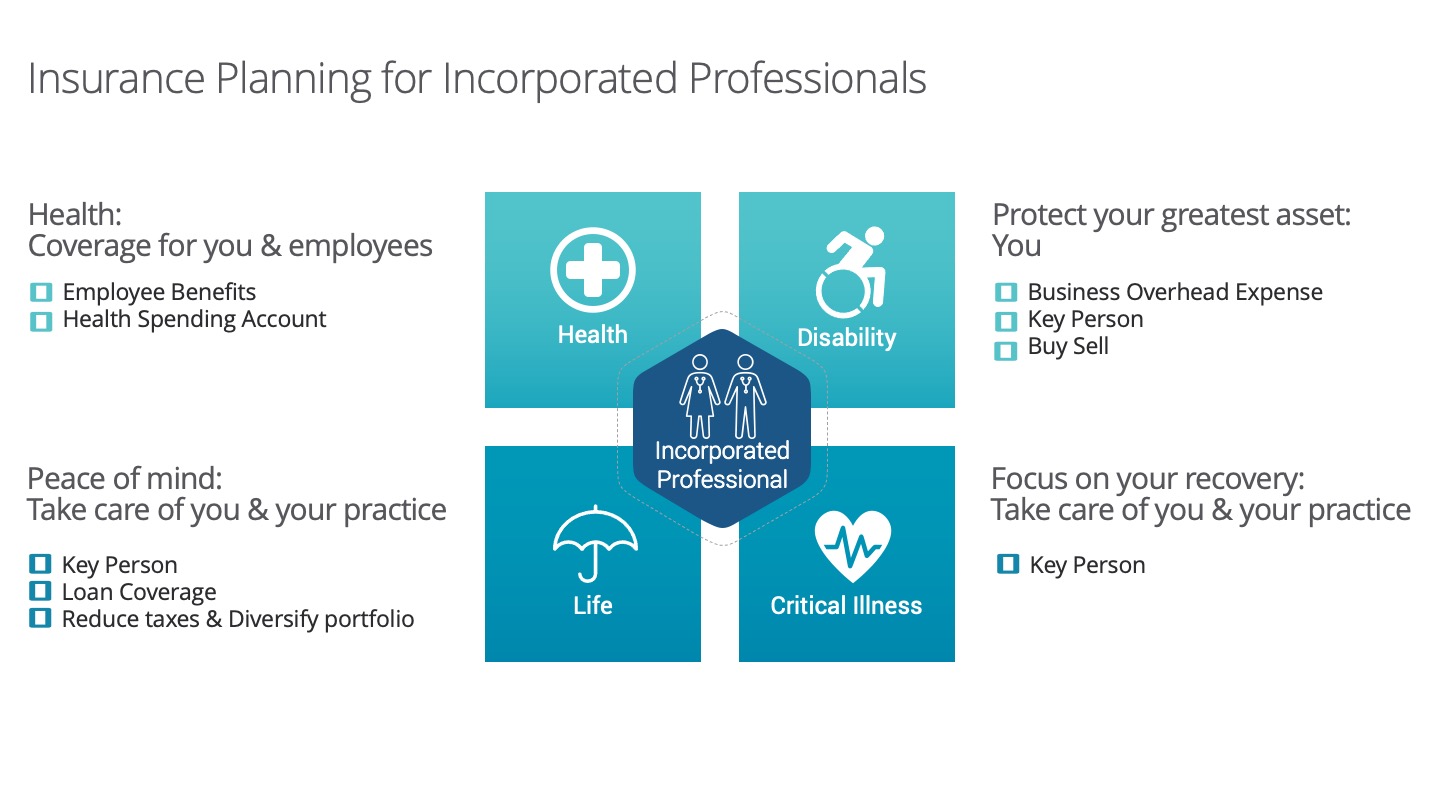
For incorporated professionals, making sure your practice is financially protected can be overwhelming. Incorporated professionals face a unique set of challenges when it comes to managing risk. Insurance can play an important role when it comes to reducing the financial impact on your practice in the case of uncontrollable events such as disability, or critical illness. This infographic and article address the importance of corporate insurance.

The 4 areas of insurance a incorporated professional should take care of are: 

  • Health 

  • Disability 

  • Critical Illness 

  • Life

Health: We are fortunate in Canada, where the healthcare system pays for basic healthcare services for Canadian citizens and permanent residents. However, not everything healthcare related is covered, in reality, 30% of our health costs* are paid for out of pocket or through private insurance such as prescription medication, dental, prescription glasses, physiotherapy, etc.

For incorporated professionals, offering employee health benefits make smart business sense because health benefits can form part of a compensation package and can help retain key employees and attract new talent.

For incorporated professionals that are looking to provide alternative health plans in a cost effective manner, you may want to consider a health spending account.

Disability: Most people spend money on protecting their home and car, but many overlook protecting their greatest asset: their ability to earn income. Unfortunately one in three people on average will be disabled for 90 days or more at least once before the age of 65.

Consider the financial impact this would have on your practice if you or a key employee were to suffer from an injury or illness. Disability insurance can provide a monthly income to help keep your practice running.

Business overhead expense insurance can provide monthly reimbursement of expenses during total disability such as rent for commercial space, utilities, employee salaries and benefits, equipment leasing costs, accounting fees, insurance premiums for property and liability, etc.

Key person disability insurance can be used to provide monthly funds for you or key employee while they’re disabled and protect the business from lost revenue while your business finds and trains an appropriate replacement.

Critical Illness: For a lot of us, the idea of experiencing a critical illness such as a heart attack, stroke or cancer can seem unlikely, but almost 3 in 4 (73%) working Canadians know someone who experience a serious illness. Sadly, this can have serious consequences on you, your family and business, with Critical Illness insurance, it provides a lump sum payment so you can focus on your recovery.

Key person critical illness insurance can be used to provide funds to the practice so it can supplement income during time away, cover debt repayment, salary for key employees or fixed overhead expenses.

Buy sell critical illness insurance can provide you with a lump sum payment if your business partner or shareholder were to suffer from a critical illness. These funds can be used to purchase the shares of the partner, fund a buy sell agreement and reassure creditors and suppliers.

Life: For an incorporated professional, not only do your employees depend on you for financial support but your loved ones do too. Life insurance is important because it can protect your practice and also be another form of investment for excess funds.

Key person life insurance can be used to provide a lump sum payment to the practice on death of the insured so it can keep the business going until you an appropriate replacement is found. It can also be used to retain loyal employees by supplying a retirement fund inside the insurance policy.

Loan coverage life insurance can help cover off any outstanding business loans and debts.

Reduce taxes & diversify your portfolio, often life insurance is viewed only as protection, however with permanent life insurance, there is an option to deposit excess funds not needed for operations to provide for tax-free growth (within government limits) to diversify your portfolio and reduce taxes on passive investments.  

Talk to us to make sure you and your practice are protected.

Contact Us
https://platinumtreefinancial.ca/wp-content/uploads/2022/10/insurancePlanningFI.jpeg 810 1440 Platinum Tree Financial https://platinumtreefinancial.ca/wp-content/uploads/2020/03/platinumTreeEnfold.jpg Platinum Tree Financial2022-10-03 06:00:002022-10-03 10:45:34Insurance Planning for Incorporated Professionals

Retirement Planning for Business Owners – Checklist

June 1, 2021/in Blog, business owners, corporate, health benefits, life insurance, long term care, pension plan, rrsp, Tax Free Savings Account/by Platinum Tree Financial

As a business owner, one of your challenges is learning how to balance between reinvesting into the business and setting money aside for personal savings. Since there are no longer employer-sponsored pension plans and the knowledge that retirement will come eventually, it’s important to have a retirement plan in place.

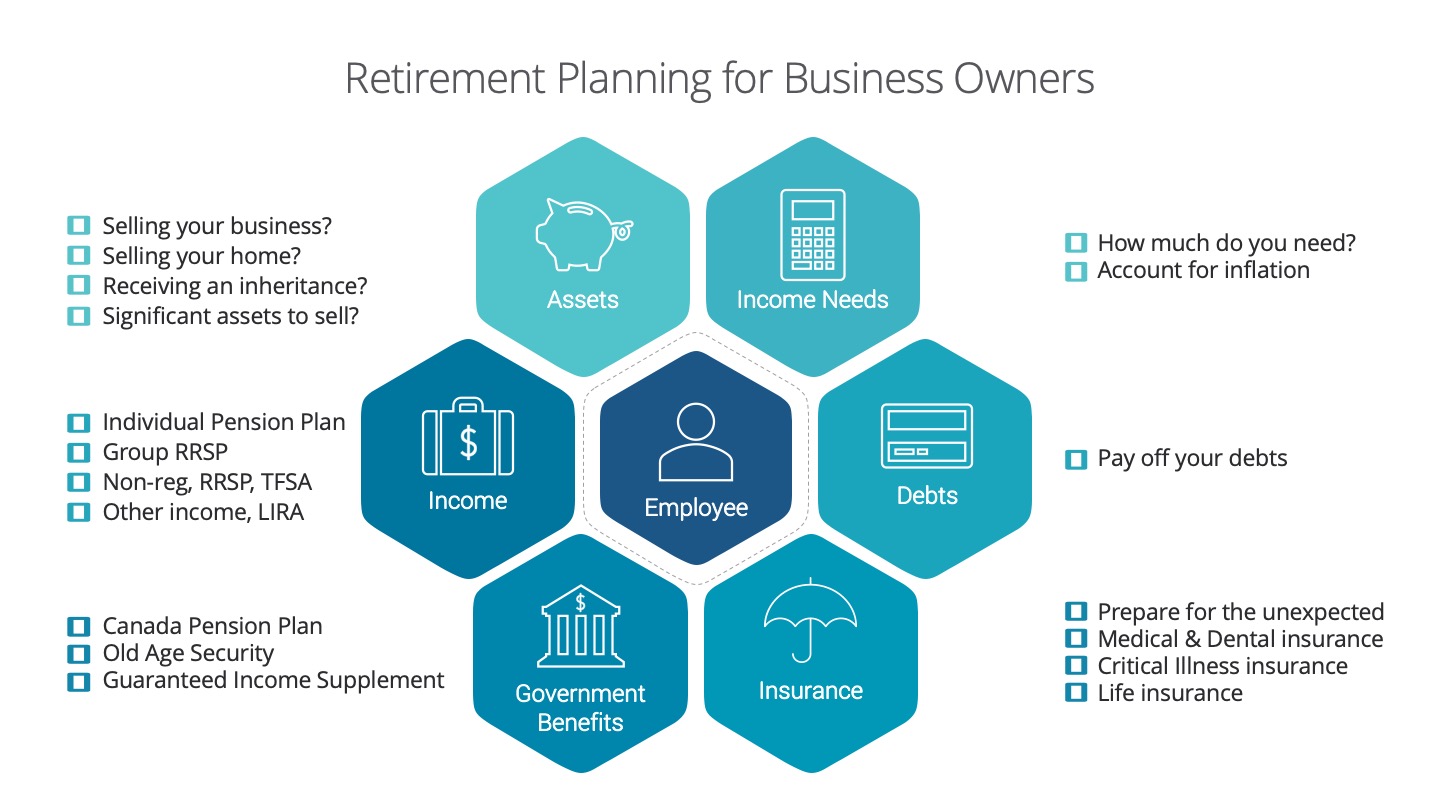
We’ve put together an infographic checklist that can help you get started on this. We know this can be a difficult conversation so we’re here to help and provide guidance to help you achieve your retirement dreams.

Income Needs

  • Determine how much income you will need in retirement.

  • Make sure you account for inflation in your calculations.

Debts

  • You should try to pay off your debts as soon as you can; preferably before you retire.

Insurance

  • As you age, your insurance needs change. Review your insurance needs, in particular your medical and dental insurance because a lot of plans do not provide health plans to retirees.

  • Review your life insurance coverage because you may not necessarily need as much life insurance as when you had dependents and a mortgage, but you may still need to review your estate and final expense needs.

  • Prepare for the unexpected such as a critical illness or a need for long-term care.

Government Benefits

  • Check what benefits are available for you upon retirement.

  • Canada Pension Plan- decide when would be the ideal time to apply and receive CPP payments. Business owners are in a unique position to control how much can be contributed to CPP by deciding to pay salary or dividends. (Dividends don’t trigger CPP contributions.)

  • Old Age Security- check pension amounts and see if there’s a possibility of clawback.

  • Guaranteed Income Supplement- if your income is low enough, you could apply for GIS.

Income

  • Are you a candidate for an individual pension plan (IPP)? IPPs can provide higher contributions than typically permitted to an RRSP and the ability to create a lifelong pension.

  • Check if your business is a candidate for a group RRSP or company pension plan. This is a great way for you to build retirement savings and provide benefits for your employees and business too.

  • Make sure you are saving on a regular basis towards retirement- in an RRSP, TFSA, or non-registered. Since you can control how you get paid, salary or dividends, dividends are not considered eligible income to create RRSP room, therefore you should make sure you have the optimal mix of both to achieve your financial goals.

  • Ensure your investment mix makes sense for your situation.

  • Don’t forget to check if there are any other income sources.  (ex. rental income, side hustle income, etc.)

Assets

  • The sale of your business can be part of your retirement nest egg. Therefore, you should make sure you know the valuation of your business and your plan to sell the business to your family, employees, partners or a third party. You should also know when you decide to sell your business too.

  • Are you planning to use the sale of your home or other assets to fund your retirement?

  • Will you be receiving an inheritance?

One other consideration that’s not included in the checklist is divorce. This can be an uncomfortable question, however divorce amongst adults ages 50 and over is on the rise and this can be financially devastating for both parties.

Next steps…

  • Contact Us about helping you get your retirement planning in order so your retirement dreams can be achieved.

https://platinumtreefinancial.ca/wp-content/uploads/2021/06/retirementPlanningBO.jpeg 810 1440 Platinum Tree Financial https://platinumtreefinancial.ca/wp-content/uploads/2020/03/platinumTreeEnfold.jpg Platinum Tree Financial2021-06-01 11:18:002021-06-01 11:27:07Retirement Planning for Business Owners – Checklist

Personal Tax Planning Tips – End of 2020 Tax Year

December 2, 2020/in 2020 Only, Blog, Charitable Gifting, Coronavirus, Coronavirus - Associates, Coronavirus - Practice Owners, Coronavirus - Retired, Coronavirus - Retiring, Coronavirus - Students, disability, disability insurance, Family, financial advice, Financial Planning, health benefits, pension plan, rdsp, Registered Education Savings Plan, rrsp, tax, Tax Free Savings Account/by Platinum Tree Financial

Now that we are reaching the end of the tax year, it’s an excellent time to review your finances. We’ve listed below some of the critical areas to consider and provide you with useful guidelines.

We have divided our tax planning tips into five sections:

  • Tax Deadlines

  • Individual tax issues

  • Family tax issues

  • Managing your investments

  • Retirement planning

Tax Deadlines for 2020 Savings

December 31, 2020:

  • If you reached the age of 71 in 2020, you can’t contribute to your RRSP after this date

  • Use up your TFSA contribution room

  • Contribute to an RESP to get the Canadian Education Savings Grant (CESG) and the income-tested Canada Learning Bond (if eligible).

  • Contribute to an RDSP to get the Canada Disability Savings Grant (CDSG) and the income-tested Canada Disability Savings Bond (if eligible).

  • Medical expenses

  • Investment counsel fees, interest and other expenses relating to investments

  • Some payments for child and spousal support

  • Fees for union and professional memberships

  • Student loan interest payments

  • Deductible legal fees

  • Charitable gifts

  • Political contributions

January 30, 2021

  • Interest on intra-family loans

  • The interest you must pay on employer loans to reduce your taxable benefit

March 1, 2021

  • Contributions to provincial labour-sponsored venture capital corporations

  • RRSP Repayment under Home Buyers Plan or Lifelong Learning Plan

  • Deductible contributions to a personal or spousal RRSP

Individual Tax Issues

To help Canadians deal with financial hardships due to job loss because of COVID-19, the Canadian government introduced several benefit programs. If you received any of these benefits, you should be aware of the tax ramifications.

The Canada Emergency Response Benefit (CERB) was the first benefit program issued by the government and ran until September 26, 2020. If you received the CERB at all during 2020, the government will issue you at T4A, showing how much money you received from the CERB program. You must then declare that as income when filing your 2020 income tax return. Since no tax was taken off at the source, be sure to put aside money to pay for potential income taxes on your CERB income.

As of September 27, 2020, the government offered three replacement benefit programs:

  • Canada Recovery Benefit (CRB)
    This is for people impacted by COVID-19 who work but are not eligible for EI (e.g. self-employed).

  • Canada Recovery Sickness Benefit (CRSB)
    This is for people who are employed cannot work due to COVID-19 and do not have access to paid sick leave.

  • Canada Recovery Caregiving Benefit (CRCB)
    This is for people who must miss work to care for a family member who has COVID-19.

For all three of these programs, the government will be withholding 10% in taxes upfront, but you may end up owing extra tax, depending on the rest of your income for 2020, so it’s important to set extra money aside for taxes.

Also, there is a unique condition for the CRB only. If you make over $38,000 in 2020 (excluding the CRB), you will have to pay back the CRB at a rate of 50 cents for each dollar of CRB you earned above the threshold.

If you paid interest on an eligible student loan in 2020, you can claim a non-refundable tax credit in the amount of interest you paid by December 31. In addition, you should be aware that student loan payments were frozen for six months – from March 30 to September 30. No interest accrued on student loans during that period.

Family Tax Issues

  • Check your eligibility for the Canada Child Benefit
    (CCB)
    To receive the Canada Child Benefit in 2021/22, you need to file your tax returns for 2020 as the benefit is calculated using your family income from the previous year. Eligibility for the CCB depends on set criteria such as your family’s income, how many children you have, and how old they are. You may qualify for a full or partial amount, depending on whether you have full custody or shared custody.

  • Consider family income splitting

    The CRA offers a prescribed low-interest rate on family loans. Therefore, it makes sense to consider setting up an income splitting loan arrangement with your family members. If you do this, you can potentially lock in a family loan at a low-interest rate of 1% and then invest the borrowed money into a higher return investment while benefitting from your family member’s lower tax status. Don’t forget to adhere to the Tax on Split Income rules.

Managing Your Investments

  • Use up your TFSA contribution room

    If you can, it’s worth contributing the full $6,000 to your TFSA for 2020. You can also contribute more (up to $69,500) if you are 29 or older and haven’t made any previous TFSA contributions.

  • Contribute to a Registered Education Savings Plan (RESP)

    The Registered Education Savings Plan (RESP) is a savings plan for parents and others to save for a child’s education. The Canada Education Savings Grant (CESG) will match up to 20% of your contributions up to a maximum of $2,500.

    That means the CESG can add a maximum of $500 to an RESP each year. The grant room accumulates until your child turns 17. Therefore, any unused CESG amounts for the current year are automatically carried forward for possible use in the future years.

    The income-tested Canada Learning Bond (CLB) is paid directly to a child’s RESP by the Canadian government to low-income families. No personal contributions are required to receive the CLB.

  • Contribute to a Registered Disability Savings Plan (RDSP)

    The Registered Disability Savings Plan (RDSP) is a savings plan for parents and others to save for the financial security of a person who is eligible for the Disability Tax Credit (DTC). The government will pay a matching Canada Disability Savings Grant (CDSG) up to 300% – depending on the beneficiary’s adjusted family net income and amount contributed.

    Also, low-income Canadians with disabilities may be eligible for a Canada Disability Savings Bond (CDSB). If you qualify, it will be paid directly to your RDSP.

    The government will pay matching grants or bonds into the RSDP up to and including the end of the year the recipient turns 49. Be aware that there is a 10-year carry-forward of CDSG and CDSB entitlements.

  • Donate securities to charity

    Donating by year-end will provide you with tax savings. If you donate eligible securities or mutual funds, capital gains tax does not apply, and you can receive a tax receipt for their full market value. Also, the charity gets the full value of the securities.

  • Think about selling any investments with unrealized capital losses

    It might be worth doing this before year-end to apply the loss against any net capital gains achieved during the last three years. The last trading date for 2020 for Canadian and US publicly traded stocks will be Tuesday December 29th in order to record the gain or loss in the 2020 taxation year.

    Conversely, if you have investments with unrealized capital gains that cannot be offset with capital losses, it may be worth selling them after 2020 to be taxed on the income the following year.

  • Consider the timing of purchasing of certain non-registered investments

    Suppose you are considering purchasing an interest-bearing investment like a guaranteed investment certificate (GIC) with a maturity date of one year or more. In that case, you may consider delaying the purchase to the following year, so you don’t have to pay tax on accrued interest until 2021. You should also consider this with mutual funds that make taxable distributions before the end of 2020, consider delaying this until early 2021. Don’t pay taxes earlier than necessary.

  • Check if you have investments in a corporation

    The new passive investment income rules apply to tax years from 2018 onwards. They state that the small business deduction is reduced for companies with between $50,000 and $150,000 of investment income. Therefore, the small business deduction has entirely stopped for corporations that earn a passive investment income of more than $150,000.

    Note – At a provincial level, both Ontario and New Brunswick do not follow the federal rules to limit access to the small business deduction.

Retirement Planning

  • Make the most of your RRSP

    The deadline for making contributions to your RRSP for the year 2020 is March 1, 2021. The deduction limit for 2020 is limited to 18% of the income you earned in 2020, to a maximum of $27,230. This maximum amount is impacted by the following:

  1. Any pension adjustment

  2. Any previous unused RRSP contribution room

  3. Any pension adjustment reversal.

Remember that deducting your RRSP contribution reduces your after-tax cost of making said contribution.

  • Check when your RRSP is due to end

    If you reach the age of 71 during 2020, you must wind up your RRSP this year. You must make your final contribution to it by December 31, 2020.

  • Convert to RRIF before year-end

    If you turned 65 during 2020 or are already older than 65, you’re entitled to a pension credit that can fully or partly offset the tax on the first $2,000 of eligible income annually. Consider setting up an RRIF before year-end to pay out $2,000 annually if you don’t have any other eligible pension income.

If you have any questions about your taxes for 2020, contact us – we can help you!

https://platinumtreefinancial.ca/wp-content/uploads/2020/12/Personal-tax-planning-tips-2020@1000px.png 563 1000 Platinum Tree Financial https://platinumtreefinancial.ca/wp-content/uploads/2020/03/platinumTreeEnfold.jpg Platinum Tree Financial2020-12-02 14:07:542020-12-02 14:21:37Personal Tax Planning Tips – End of 2020 Tax Year

Business Overhead Expense Insurance

October 1, 2020/in Blog, Business Owners, buy sell, corporate, disability insurance, Group Benefits, health benefits, Insurance, life insurance, travel insurance/by Platinum Tree Financial

For business owners, making sure your business is financially protected can be overwhelming. Business owners face a unique set of challenges when it comes to managing risk. Insurance can play an important role.

Read more
https://platinumtreefinancial.ca/wp-content/uploads/2020/10/nayeli-dalton-GIJWGUXKEzY-unsplash.jpg 794 1000 Platinum Tree Financial https://platinumtreefinancial.ca/wp-content/uploads/2020/03/platinumTreeEnfold.jpg Platinum Tree Financial2020-10-01 09:19:002020-10-14 08:03:07Business Overhead Expense Insurance

Insurance Planning for Business Owners

September 1, 2020/in Blog, Business Owners, buy sell, corporate, disability insurance, Group Benefits, health benefits, Insurance, life insurance, travel insurance/by Platinum Tree Financial

For business owners, making sure your business is financially protected can be overwhelming. Business owners face a unique set of challenges when it comes to managing risk. Insurance can play an important role when it comes to reducing the financial impact on your business in the case of uncontrollable events such as disability, critical illness or loss of a key shareholder or employee.

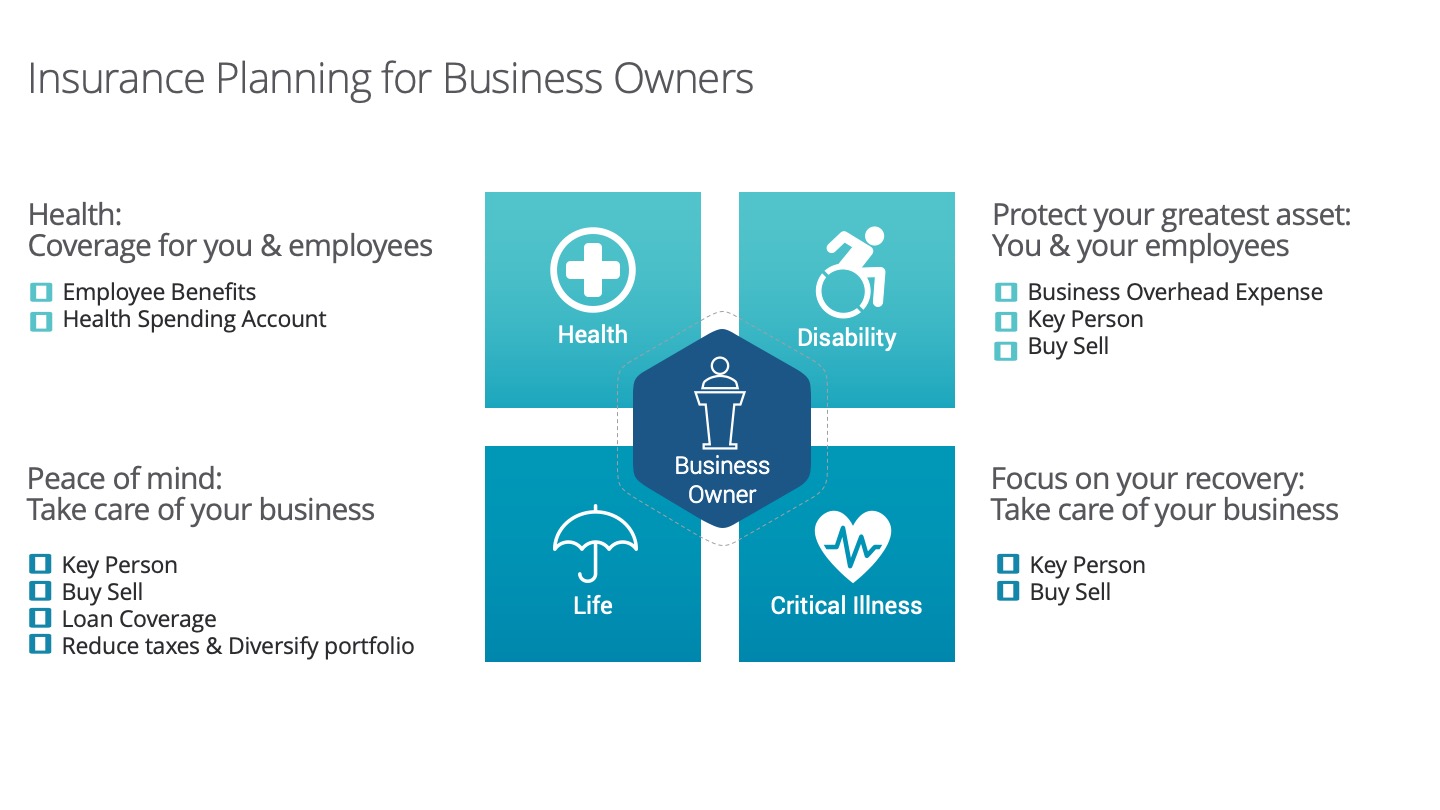
This infographic addresses the importance of corporate insurance.

The 4 areas of  insurance a business owner should take care of are:

  • Health

  • Disability

  • Critical Illness

  • Life

Health: We are fortunate in Canada, where the healthcare system pays for basic healthcare services for Canadian citizens and permanent residents. However, not everything healthcare related is covered, in reality, 30% of our health costs* are paid for out of pocket or through private insurance such as prescription medication, dental, prescription glasses, physiotherapy, etc.

For business owners, offering employee health benefits make smart business sense because health benefits can form part of a compensation package and can help retain key employees and attract new talent.

For business owners that are looking to provide alternative health plans in a cost effective manner, you may want to consider a health spending account.

Disability: Most people spend money on protecting their home and car, but many overlook protecting their greatest asset: their ability to earn income. Unfortunately one in three people on average will be disabled for 90 days or more at least once before the age of 65.

Consider the financial impact this would have on your business if you, a key employee or shareholder were to suffer from an injury or illness. Disability insurance can provide a monthly income to help keep your business running.

Business overhead expense insurance can provide monthly reimbursement of expenses during total disability such as rent for commercial space, utilities, employee salaries and benefits, equipment leasing costs, accounting fees, insurance premiums for property and liability, etc.

Key person disability insurance can be used to provide monthly funds for the key employee while they’re disabled and protect the business from lost revenue while your business finds and trains an appropriate replacement.

Buy sell disability insurance can provide you with a lump sum payment if your business partner were to become totally disabled. These funds can be used to purchase the shares of the disabled partner, fund a buy sell agreement and reassure creditors and suppliers.

Critical Illness: For a lot of us, the idea of experiencing a critical illness such as a heart attack, stroke or cancer can seem unlikely, but almost 3 in 4 (73%) working Canadians know someone who experience a serious illness. Sadly, this can have serious consequences on you, your family and business, with Critical Illness insurance, it provides a lump sum payment so you can focus on your recovery.

Key person critical illness insurance can be used to provide funds to the company so it can supplement income during time away, cover debt repayment, salary for key employees or fixed overhead expenses.

Buy sell critical illness insurance can provide you with a lump sum payment if your business partner or shareholder were to suffer from a critical illness. These funds can be used to purchase the shares of the partner, fund a buy sell agreement and reassure creditors and suppliers.

Life: For a business owner, not only do your employees depend on you for financial support but your loved ones do too. Life insurance is important because it can protect your business and also be another form of investment for excess company funds.

Key person life insurance can be used to provide a lump sum payment to the company on death of the insured so it can keep the business going until you an appropriate replacement is found. It can also be used to retain loyal employees by supplying a retirement fund inside the insurance policy.

Buy sell life insurance can provide you with a lump sum payment if your business partner or shareholder were to pass away. These funds can be used to purchase the shares of the deceased partner, fund a buy sell agreement and reassure creditors and suppliers.

Loan coverage life insurance can help cover off any outstanding business loans and debts.

Reduce taxes & diversify your portfolio, often life insurance is viewed only as protection, however with permanent life insurance, there is an option to deposit excess company funds not needed for operations to provide for tax-free growth (within government limits)  to diversify your portfolio and reduce taxes on passive investments.

Talk to us about helping making sure you and your business are protected.

Contact Us
https://platinumtreefinancial.ca/wp-content/uploads/2020/09/insurancePlanningforBusinessOwnersFI.jpg 810 1440 Platinum Tree Financial https://platinumtreefinancial.ca/wp-content/uploads/2020/03/platinumTreeEnfold.jpg Platinum Tree Financial2020-09-01 09:19:002020-09-01 09:27:08Insurance Planning for Business Owners

Insurance Planning for Young Families

June 1, 2020/in Blog, disability insurance, Family, health benefits, Insurance, life insurance, travel insurance/by Platinum Tree Financial

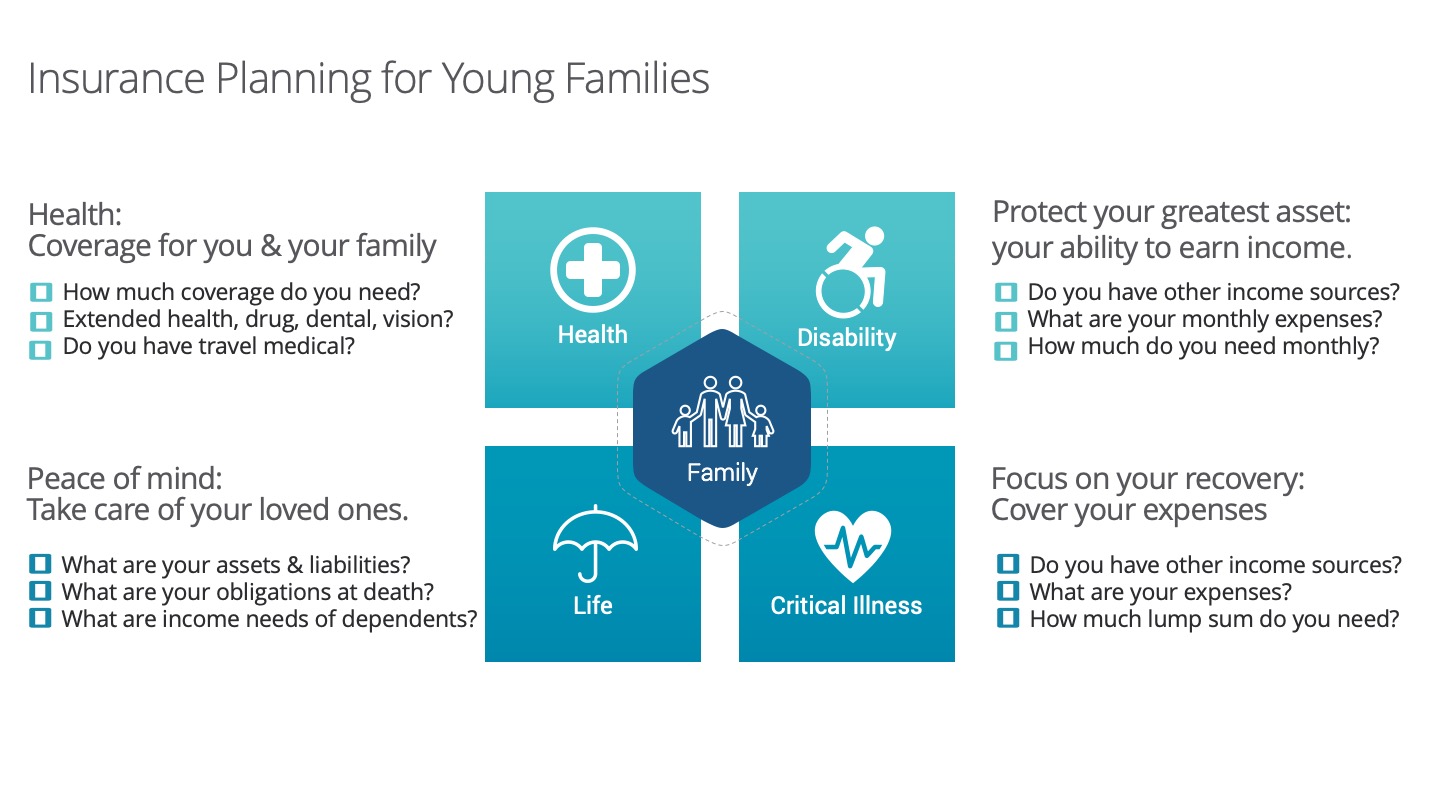
For young families, making sure your family is financially protected can be overwhelming, especially since there’s so much information floating online. This infographic addresses the importance of insurance- personal insurance.

The 4 areas of personal insurance a young family should take care of are:

  • Health

  • Disability

  • Critical Illness

  • Life

Health: We are so fortunate to live in Canada, where the healthcare system pays for basic healthcare services for Canadian citizens and permanent residents. However, not everything healthcare related is covered, in reality, 30% of our health costs* are paid for out of pocket or through private insurance such as prescription medication, dental, prescription glasses, physiotherapy, etc.. Moreover, if you travel outside of Canada, medical emergencies can be extremely expensive.

Disability: Most people spend money on protecting their home and car, but many overlook protecting their greatest asset: their ability to earn income. Unfortunately one in three people on average will be disabled for 90 days or more at least once before age 65. Disability insurance can provide you with a portion of your income if you were to become disabled and unable to earn an income.

Critical Illness: For a lot of us, the idea of experiencing a critical illness such as a heart attack, stroke or cancer can seem unlikely, but almost 3 in 4 (73%) working Canadians know someone who experience a serious illness. Sadly, this can have serious consequences on you and your family, with Critical Illness insurance, it provides a lump sum payment so you can focus on your recovery.

Life: For young families, if your loved ones depend on you for financial support, then life insurance is absolutely necessary, because it replaces your income, pay off your debts and provides peace of mind.

Talk to us about helping making sure you and your family are protected.

Contact Us
https://platinumtreefinancial.ca/wp-content/uploads/2020/06/insurancePlanningYoungFamiliesFI.jpeg 810 1440 Platinum Tree Financial https://platinumtreefinancial.ca/wp-content/uploads/2020/03/platinumTreeEnfold.jpg Platinum Tree Financial2020-06-01 09:19:002020-06-01 09:27:06Insurance Planning for Young Families

Book a Meeting

Search Blog Posts

Search Search

Latest News

  • Budget 2026: What the New Federal Measures Could Mean for Your MoneyNovember 6, 2026 - 9:33 am
  • Disability Insurance for Parents and Caregivers: What Happens to Your Income If You Can’t Work?November 2, 2026 - 4:25 pm
  • What Happens to Your Group Benefits When You Leave a Job?October 1, 2026 - 9:03 am

Categories

  • 2020
  • 2020 Only
  • 2021
  • 2022
  • 2022 Only
  • 2023
  • 2024
  • 2025
  • 2026
  • Accountants
  • Article
  • Blog
  • Budget
  • Business Owners
  • business owners
  • buy sell
  • Center of Influences
  • Charitable Gifting
  • Coronavirus
  • Coronavirus – Associates
  • Coronavirus – Practice Owners
  • Coronavirus – Retired
  • Coronavirus – Retiring
  • Coronavirus – Students
  • corporate
  • critical illness insurance
  • Debt
  • dental benefits
  • disability
  • disability insurance
  • Estate Planning
  • Families
  • Family
  • farmers
  • financial advice
  • Financial Planning
  • Government Budget
  • Group Benefits
  • health benefits
  • incorporated professionals
  • individuals
  • Insurance
  • Investment
  • life insurance
  • long term care
  • mortgage
  • pension plan
  • personal finances
  • Professional Corporations
  • Professionals
  • rdsp
  • Registered Education Savings Plan
  • Retirees
  • retirement
  • rrsp
  • tax
  • Tax Free Savings Account
  • travel insurance

Adrian Belcourt

Financial Advisor
T: (780) 850-8020
E: Adrian@platinumtreefinancial.ca

About

Educate, Empower, Enjoy

Latest News

  • Budget 2026: What the New Federal Measures Could Mean for Your MoneyNovember 6, 2026 - 9:33 am
  • Disability Insurance for Parents and Caregivers: What Happens to Your Income If You Can’t Work?November 2, 2026 - 4:25 pm
  • What Happens to Your Group Benefits When You Leave a Job?October 1, 2026 - 9:03 am
©2020 Financial Tech Tools Inc. | Privacy Statement and Terms of Use
  • Link to LinkedIn
  • Link to Facebook
  • Link to LinkedIn
  • Link to LinkedIn
Scroll to top Scroll to top Scroll to top